
Short answer: For a reliable, repeat-harvest crop, plant cranberries on Fall 1: five harvests of two base berries can return 750g, or about 510g after one 240g seed. If you mean the biggest one-crop sale, a Sweet Gem Berry is the outlier: a Rare Seed bought for 1,000g and planted by Fall 4 can sell for 3,000g, for 2,000g net. It is a scarce, one-harvest option, not a normal seed-shop crop. Pumpkins are a strong middle ground: two Fall 1 plantings can net about 440g per tile under the assumptions below.
That distinction matters when you search for the best fall crop in Stardew Valley. A large sale, a repeatable harvest, a low-cost first-year choice, and a crop that helps a Community Center bundle are different goals. This guide compares all four using a visible 28-day calendar, then gives the last useful sowing dates so late seeds do not get counted as fall profit when they mature in winter.
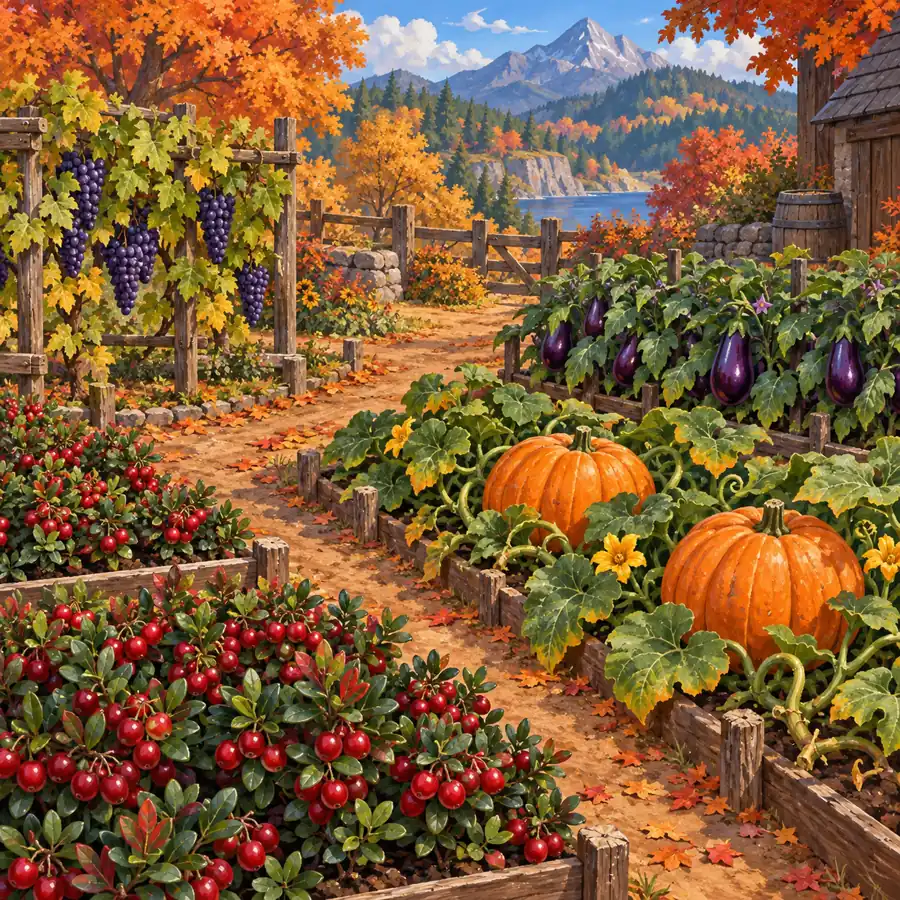
How to compare Stardew Valley fall crops across 28 days
The table uses one tilled tile, a Fall 1 start, normal-quality base sell prices, and enough seed money to replant a single-harvest crop after each harvest. Net gold means all base-price harvests sold minus every seed bought. It does not include fertilizer, crop quality, farming professions, artisan processing, tool costs, or random extra produce. Those can change a save's result, so treat these figures as a reproducible baseline rather than a promise.
For regrow crops, the first growth period and each later harvest interval both count. Cranberries give two berries per harvest at base, and grapes regrow, but a grape trellis occupies a tile the farmer cannot walk through. For single-harvest crops, the calculation assumes you replant on the harvest day when another crop can mature by Fall 28. A crop that matures on Fall 29 belongs to winter for this comparison.
Prices use the site's Stardew Valley 1.6.15 PC base-price snapshot, last verified against crop references on September 23, 2026. That is the dataset boundary, not a claim that 1.6.15 is the newest game version. Check the linked crop pages if your platform, mod, remixed rules, or later game update changes a value.
Stardew Valley fall crops ranked by one-tile season profit
These estimates assume the first seed is planted on Fall 1 and include the cost of every replacement seed. The Sweet Gem Berry is shown separately because it comes from a limited Rare Seed rather than Pierre's regular fall crop shelf.
| Crop and fit | Fall harvest schedule | Base sales | Seed cost | Net by Fall 28 |
|---|---|---|---|---|
| Sweet Gem Berry Highest one-harvest return if a Rare Seed is available | Plant by Fall 4; one harvest after 24 days | 1 × 3,000g = 3,000g | 1 × 1,000g = 1,000g* | 2,000g* |
| Cranberries Best repeatable base-price crop in this comparison | Fall 8, 13, 18, 23, 28; two berries per harvest | 10 × 75g = 750g | 240g | 510g |
| Pumpkin High-value seed-shop crop, useful for bundles | Fall 14 and 27, replanting after the first harvest | 2 × 320g = 640g | 2 × 100g = 200g | 440g |
| Grape Strong total with a trellis path cost | Fall 11, 14, 17, 20, 23, 26 | 6 × 80g = 480g | 60g | 420g |
| Artichoke Year 2+ seed access | Fall 9, 17, 25; replant after harvest | 3 × 160g = 480g | 3 × 30g = 90g | 390g |
| Eggplant Very low seed cost and repeat harvests | Fall 6, 11, 16, 21, 26 | 5 × 60g = 300g | 20g | 280g |
| Amaranth Three practical turns from a Fall 1 start | Fall 8, 15, 22; the next turn misses the season | 3 × 150g = 450g | 3 × 70g = 210g | 240g |
| Yam Simple two-harvest single-crop route | Fall 11 and 21 | 2 × 160g = 320g | 2 × 60g = 120g | 200g |
| Bok Choy Fast, but many replant actions | Fall 5, 9, 13, 17, 21, 25 | 6 × 80g = 480g | 6 × 50g = 300g | 180g |
*Rare Seeds can have a different purchase price depending on when and where they are bought. The 2,000g net example uses a 1,000g seed. If your cart price is lower, subtract that actual cost instead. The rare crop must be planted early enough to mature before Winter 1.
Are cranberries or pumpkins the best fall crop?
Choose cranberries when you can afford the 240g seed and want several harvest mornings from one planting. A Fall 1 seed matures on Fall 8, then regrows every five days. Five harvests produce ten base berries, worth 750g before the seed cost. This is why cranberry is the practical answer to “what is the most profitable repeat-harvest crop?” rather than the answer to every version of “best crop.” Random bonus berries can raise the actual total, but they are not counted here.
Pumpkins fit a different plan. Their 13-day growth makes two harvests possible from a Fall 1 planting if you replant on Fall 14: the second pumpkin matures on Fall 27. Two seeds cost 200g and two base pumpkins sell for 640g, leaving 440g net. If you miss the first days of fall, pumpkin can still make money from one harvest, but the second turn is no longer available.
Sweet Gem Berry wins only under the narrow “one tile, raw sale value, Rare Seed already obtained” question. A 3,000g base sale minus a 1,000g seed is 2,000g net, but the seed is limited stock and the crop is not a repeat-harvest shop staple. Do not plan a full field around a supply you may not find. For steady expansion, cranberries are easier to scale; pumpkins are more accessible for a first-year player and Community Center planning.
Match the crop to the job
For low starting gold, eggplant is forgiving because the seed costs 20g and the first harvest already clears that cost. For a trellis-free field, prefer cranberries, pumpkins, eggplants, yams, or bok choy over grapes. If you are turning crops into preserves or juice, recalculate with the machine output and processing time; the table intentionally compares raw crops so one shared price basis stays visible.
First-year fall crops: start with seed access and cash
Most standard fall seeds are available from Pierre during the season, but Artichoke is a Year 2+ purchase. Rare Seeds come from the Traveling Cart, so a first-year route depends on whether one appears early enough. If it does, plant it by Fall 4 for a harvest before the season changes. If it does not, do not delay the whole field while waiting for a Sweet Gem Berry.
With enough cash, split the field: use cranberries for repeat income, plant pumpkins for their higher single sale and bundle needs, and keep a small eggplant row for a low-cost repeat harvest. A new save often has other Fall expenses, including animals, buildings, tool upgrades, and Community Center items. You do not need to buy 30 cranberry seeds to follow the crop guide; buy a number you can water and harvest without borrowing money from the next goal.
For a simple first-year answer: choose cranberries when your budget covers the seed and you can use the five harvest dates; choose pumpkins when a bundle or larger individual sale matters; choose eggplants when cash is tight; take a Rare Seed only when the cart offers one early enough and the 1,000g outlay will not block a more urgent upgrade. The word “best” depends on which of those constraints applies to your save.
Latest planting dates for fall crops
Late planting changes the crop ranking. Count backward from Fall 28, and for a repeat-harvest crop include enough time for every later cycle you want to collect. If a seed matures after the season, it withers at the season change instead of becoming fall income.
| Goal | Latest practical planting date | Why |
|---|---|---|
| Five cranberry harvests | Fall 1 | First pick Fall 8, then every five days through Fall 28 |
| At least two cranberry harvests | Fall 16 | Harvest Fall 23 and 28; one harvest alone does not repay the 240g seed at base price |
| Second pumpkin harvest | Fall 2 | First pick Fall 15; replant the same day for Fall 28 |
| Two yam harvests | Fall 8 | Pick Fall 18, replant, and pick Fall 28 |
| One pumpkin harvest | Fall 15 | 13 growth days to mature by Fall 28 |
| One cranberry harvest | Fall 21 | Seven growth days to mature by Fall 28; the base sale is below the seed cost |
| One Sweet Gem Berry | Fall 4 | 24 growth days to mature by Fall 28 |
These are base-growth cutoffs without Speed-Gro, agriculturist profession bonuses, or other timing effects. If you use a growth bonus, check its effect for your version and calculate from the adjusted growth time. For the basic plan, a late cranberry planting can still return a positive amount if it has two picks, while a late pumpkin or Sweet Gem Berry may have one profitable harvest but no time for another crop cycle.
Keep bundle crops and trellis paths in the plan
A season-profit table does not replace your Community Center list. Pumpkin is a Pantry bundle item in standard bundles, while eggplant, yam, and corn can matter for the Fall Crops Bundle. Check your own bundle variant before selling the full harvest; remixed bundles can change the requirement. The site's Community Center checklist can help track items, and the spring crop guide compares the same 28-day method for the previous season.
Grapes earn 420g in this schedule but grow on trellises. Trellis tiles block movement, so a long crop row can cut off a shortcut between the house, shipping bin, or greenhouse. Put trellises at the edge of a plot or leave an open lane before planting. The farm layout guide covers route planning, while the homepage crop profit calculator lets you change seed cost, sell price, and harvest count.
The calculator performs the arithmetic you enter; it does not automatically know that cranberries make two base berries, that grapes regrow on a trellis, or that the Traveling Cart's Rare Seed availability is limited. Enter every seed purchase and each harvest explicitly. If you want to compare preserves or wine, use the processed sale value and account for machine capacity and processing time rather than mixing those values into the raw-crop ranking above.
Fall crop questions
What is the best repeat-harvest fall crop in Stardew Valley?
For a Fall 1 planting and base-quality raw sales, cranberries lead this comparison: five harvests of two base berries make 750g, and the 240g seed leaves about 510g net. Random bonus berries are excluded.
What is the most profitable single fall crop?
A Sweet Gem Berry can return 2,000g net if you buy a Rare Seed for 1,000g and plant it by Fall 4. The seed is limited stock and the crop harvests once, so this is a conditional one-tile example rather than a scalable seed-shop plan.
Are cranberries or pumpkins better in fall?
Cranberries are better for repeat harvests from one seed. Pumpkins have a larger individual sale and can produce two Fall harvests from a Fall 1 start if replanted on Fall 14. The table's base net estimates are 510g for cranberries and 440g for two pumpkins.
What should I plant in my first fall?
With enough cash, use cranberries for recurring sales and keep pumpkins or eggplants for bundle needs. Eggplant has a 20g seed and repeats every five days. A Rare Seed is an optional choice only if it appears early and does not block another first-year expense.
When is it too late to plant cranberries?
Fall 21 is the latest date for one base harvest by Fall 28, but that one sale does not repay a 240g seed. Fall 16 is the latest start for two picks, on Fall 23 and 28, which makes the base-price result positive.
When should I plant pumpkins for two fall harvests?
Plant by Fall 2. The first pumpkin is ready on Fall 15; replant that day and the second matures on Fall 28. A Fall 1 start gives the same two harvests with more scheduling room.
Can I still earn money from late fall seeds?
Often, but check the crop's remaining growth time. A single pumpkin planted by Fall 15 or cranberry planted by Fall 21 can mature before winter. A single cranberry pick is still below its seed cost, so its profitability depends on reaching a second harvest.
Do preserves jars or professions change which fall crop is best?
Yes. Processing, professions, fertilizer, quality, and growth bonuses can change revenue or timing. This comparison excludes them. Recalculate with your actual sale route and include the number of machines and processing days available.
Does the crop calculator know cranberry and grape harvest schedules?
No. The homepage calculator uses the costs, prices, growth days, and harvest count you enter. Add the cranberry yield of two berries per harvest and remember that grape trellises block walking; the calculator does not infer either rule.
Bottom line
Cranberries are the dependable repeat-harvest pick: a Fall 1 planting has five base harvests and about 510g net per tile after seed cost. Sweet Gem Berry has the largest one-crop return when you find and plant a Rare Seed by Fall 4. Pumpkins offer two useful turns from an early planting, and eggplant keeps the cost low. Use the deadline table before buying late seeds, then reserve any bundle items before selling the rest.
Sources and scope: Stardew Valley Wiki: Crops, Cranberries, Pumpkin, Eggplant, Grape, Yam, Artichoke, Sweet Gem Berry, Rare Seed, Bok Choy, and Amaranth. Prices use the site's Stardew Valley 1.6.15 PC base-price snapshot, checked against crop references on September 23, 2026; this is not a latest-version claim. Figures exclude quality, fertilizer, professions, processing, and random bonuses. Sweet Gem Berry net uses the stated 1,000g seed example; use your actual cart price.